
PPWR recycled content targets: what the regulation actually requires, and from when
You still hear that the PPWR is about PET bottles. It isn't. The EU's new packaging regulation sets a minimum share of recycled plastic for almost every plastic package sold in the Union, from yoghurt pots to the stretch wrap holding your pallets together.
Here is what the text actually says, and what it means if you buy or process recycled material.
A regulation, not a directive
The PPWR (Regulation (EU) 2025/40 on packaging and packaging waste) entered into force on 11 February 2025 and has applied since 12 August 2026. Like any EU regulation, it applies as written in all 27 member states, with no national transposition. A country may add its own requirements, but it may not block packaging that complies with the regulation (Article 4).
"Applies" does not mean every obligation bites today. The text is phased. Some rules are already live, such as the PFAS limits for food-contact packaging (Article 5). The recycled content obligations start in 2030.
Four categories, four rates
Article 7 sets a minimum recycled content for every plastic part of a package. The rate depends on the category:
| Category | Example | 2030 | 2040 |
|---|---|---|---|
| Contact-sensitive packaging made mainly of PET (excluding beverage bottles) | PET food tray | 30% | 50% |
| Contact-sensitive packaging made of other plastics (excluding beverage bottles) | PP yoghurt pot, HDPE shampoo bottle | 10% | 25% |
| Single-use plastic beverage bottles | Water bottle | 30% | 65% |
| All other plastic packaging | Laundry detergent bottle, pallet stretch wrap | 35% | 65% |
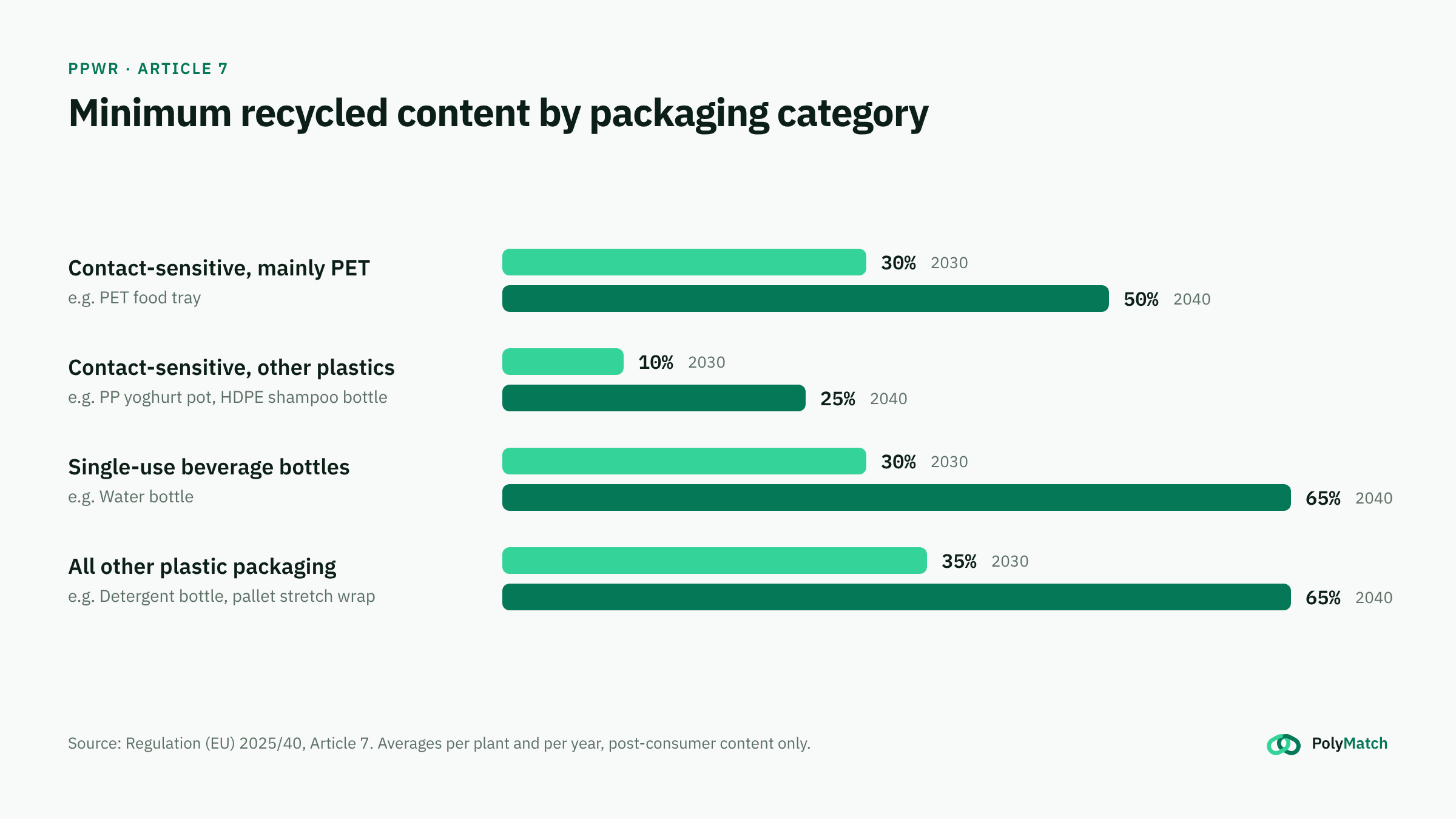
"Contact-sensitive" covers packaging for products that fall under health and safety rules: food, cosmetics, medicines, medical devices, animal feed and food supplements, among others (Article 3). The beverage bottles concerned are those defined in the Single-Use Plastics Directive: up to 3 litres, caps and lids included.
Two quick readings of this table lead people astray.
The first is to treat 35% as "the" PPWR rate. A PP yoghurt pot only needs 10% in 2030. On the other hand, your pallet stretch wrap is caught at 35%, because the regulation also covers transport packaging.
The second is to assume every single package must hit the rate. The figure is an average, per manufacturing plant and per year, for each packaging type. The detailed calculation rules will come from an implementing act, covered just below.
The date: 2030, or later
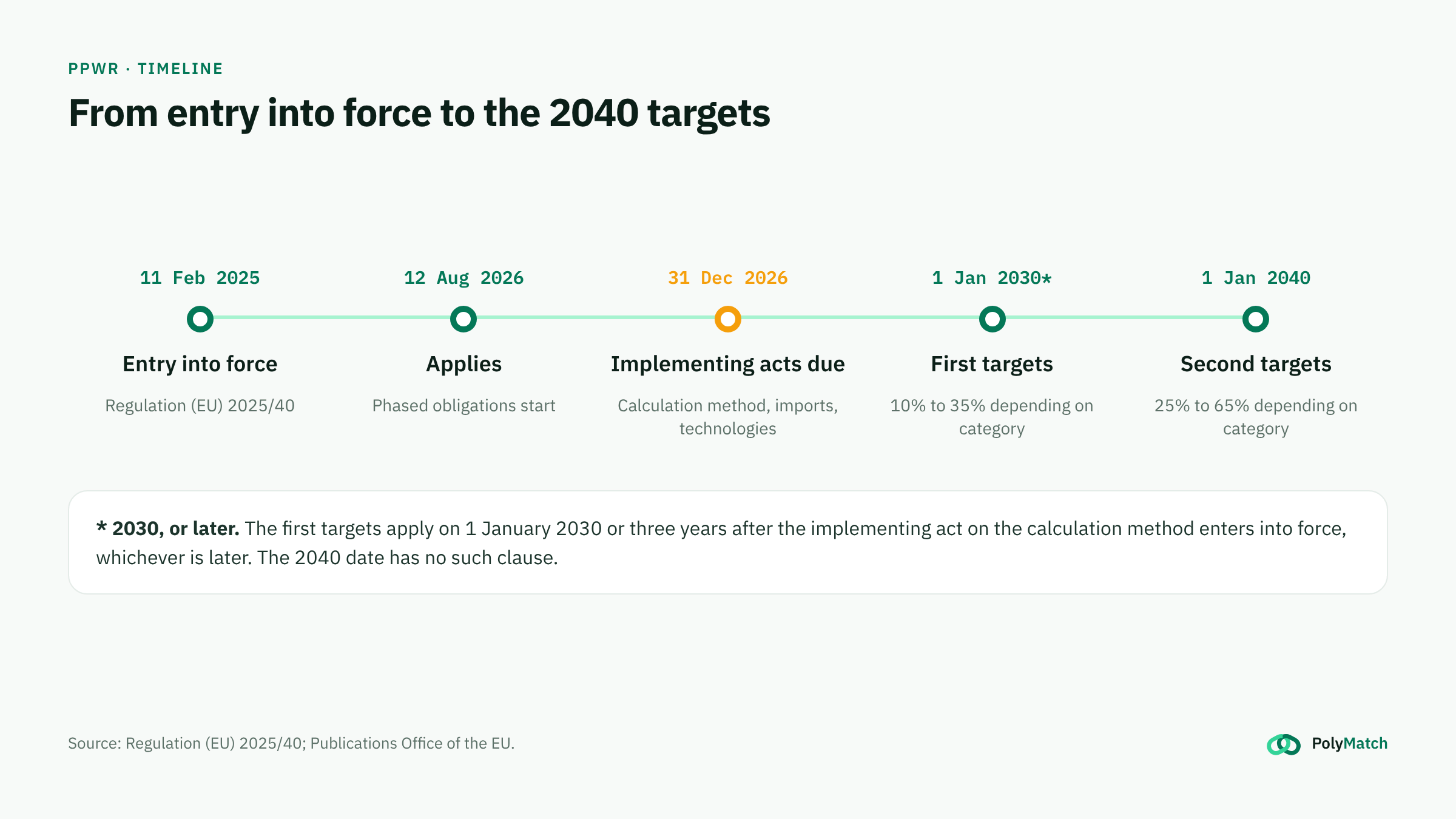
The text does not say "from 1 January 2030". It says: by 1 January 2030, or three years after the entry into force of the implementing act setting the calculation method, whichever is later. The 2040 date has no such clause.
The Commission has until 31 December 2026 to adopt that act. It collected industry feedback until 16 September 2026. Not everyone believes the timetable: the director general of the German Plastic Packaging Association expects a delay of at least several months. And once 1 January 2027 has passed, every month the act slips pushes the obligation back by a month.
A few months make little difference to a sourcing plan. The date that matters is the publication of the act, because it will define how you prove your figures.
What counts as recycled content, and what doesn't
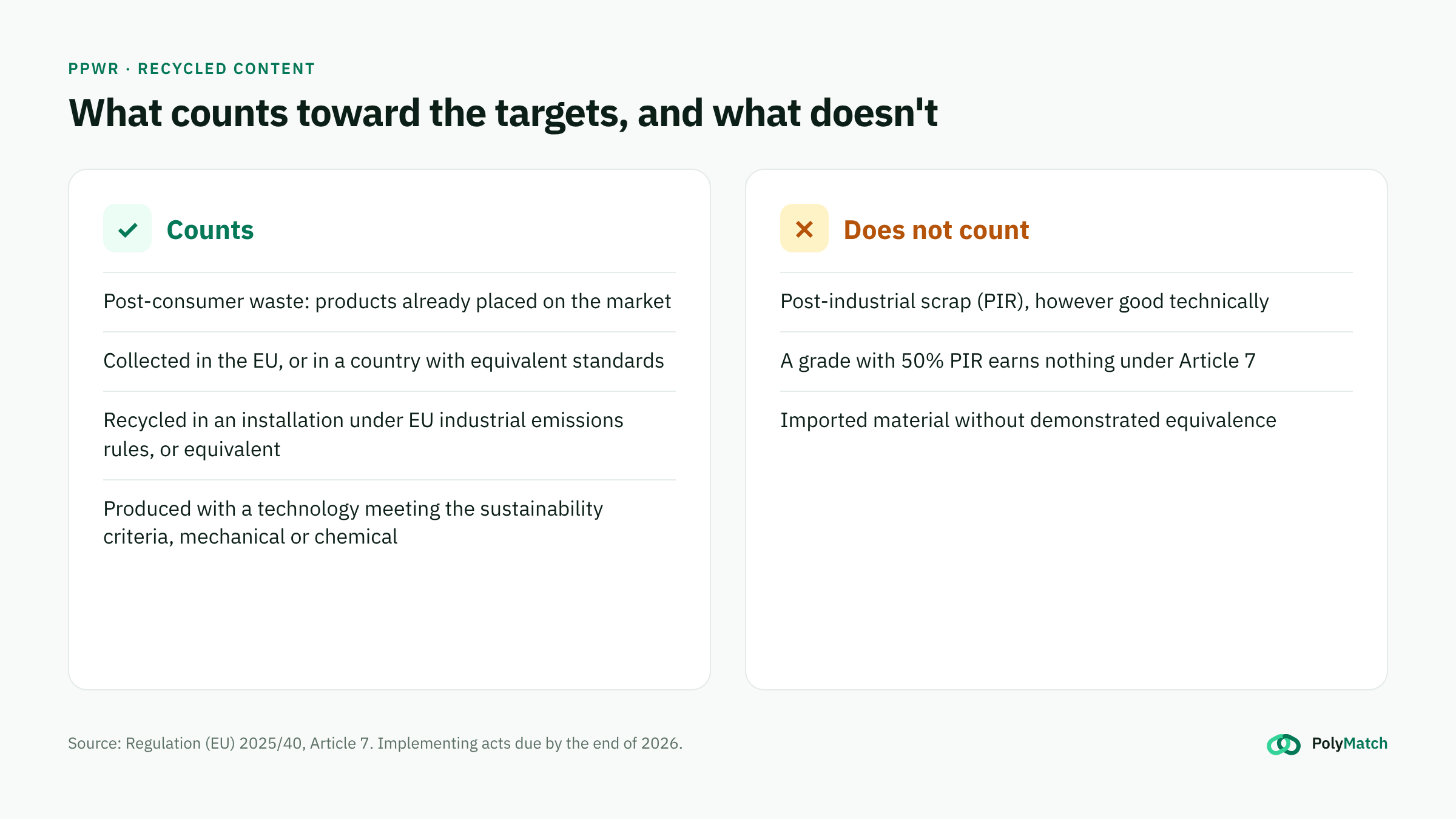
Only recycled content from post-consumer waste counts, meaning plastic from products that have already been placed on the market. Reprocessed production scrap (post-industrial, or PIR) is left out. A grade with 50% PIR earns you nothing under Article 7, however good it is technically.
The waste must also have been collected in the EU under EU rules, or in a non-EU country with equivalent standards. And it must have been recycled in an installation covered by EU industrial emissions rules, or by equivalent rules outside the EU. For imported material, a separate act, also due by the end of 2026, will set out how to demonstrate that equivalence.
A third act is due on the same date: sustainability criteria for recycling technologies. Only recycled content produced with a technology that meets them will count, whether that technology is mechanical or chemical.
Who has to prove what
The obligation falls on the packaging manufacturer or the importer. Watch the definition: under the regulation, the manufacturer also includes whoever has packaging made under its own name or trademark (with a special case for micro-enterprises). A brand that outsources its bottles is therefore the "manufacturer". Compliance is demonstrated in the packaging's technical documentation.
That does not let converters off the hook. Any supplier of packaging or packaging materials must give the manufacturer the information and documents it needs to prove compliance (Article 16). Expect your customers to ask for the post-consumer recycled share of your parts, with evidence. And you will have to get that evidence from your recycler.
What evidence? For now, the regulation does not require any specific certification. The implementing act may make independent third-party audits mandatory, in particular for producers of recycled plastic. In the meantime, the safest route is to ask your supplier for a traceability certification that separates post-consumer from post-industrial material. We cover certifications, and how they differ, in a separate article.
The safety valves in the text
The regulation includes three adjustment mechanisms.
By 1 January 2028, the Commission must assess whether derogations are needed for non-PET contact-sensitive packaging and for the "other" category, in particular where suitable recycling technologies are not authorised or not available in practice.
It can also lower the rates if a recycled plastic is unavailable or excessively expensive, but only in exceptional cases where this would seriously harm health, food supply security or the environment.
Finally, by 12 February 2032, it must review the 2030 targets and may propose changes to the 2040 ones.
None of these valves is automatic. Don't build a plan around them.
Exemptions
The minimums do not apply to, among others, compostable packaging, immediate packaging of medicines, contact-sensitive packaging of medical devices and in vitro diagnostics, food packaging intended for infants and young children, and packaging for the transport of dangerous goods. Any plastic part weighing less than 5% of the whole packaging unit is also excluded. Lastly, the minimum does not apply to food-contact packaging where the amount of recycled content would threaten human health and make the packaged product non-compliant with Regulation (EC) No 1935/2004 on food contact materials.
Before the PPWR: the SUP Directive and bottles
The idea that "the PPWR is about PET bottles" comes from a different law: Directive (EU) 2019/904 on single-use plastics, known as the SUP Directive. It requires PET beverage bottles to contain at least 25% recycled plastic from 2025, and all beverage bottles 30% from 2030.
The difference with the PPWR is significant. Those rates are averages across all bottles placed on each country's market, and each member state enforces them through its own transposition rules. The EU calculation method for these bottles has also just been revised: on 30 June 2026 the Commission adopted a new version that also covers chemical recycling, using mass balance accounting.
The PPWR takes over the 30% rate for bottles and extends recycled content requirements to almost all plastic packaging. Until then, rules differ from one country to the next: each member state transposed the SUP Directive in its own way, and some, such as Spain, tax non-recycled plastic. We look at this country by country in a separate article.
What this means for you
If you process or buy plastics, there are three things to do now.
Sort your packaging into the four categories. One plant can fall under several rates, since the calculation is per packaging type.
Ask for the post-consumer share, not just the "recycled" share. A datasheet that says "50% recycled" without saying where the material comes from tells you nothing about what will count in 2030.
Secure material early. Every manufacturer and importer placing packaging on the EU market will have to hit these rates at the same time, then move to 65% by 2040 for beverage bottles and the "other" category.
One last point for brand owners: once the minimums apply, printing the legal rate on a pack will no longer be a selling point. The regulation only allows an environmental claim on this property if the packaging goes beyond the required minimum (Article 14).
Sources
- Regulation (EU) 2025/40 of the European Parliament and of the Council of 19 December 2024 on packaging and packaging waste, official text, in particular Articles 2, 3, 4, 5, 7, 14 and 16: https://eur-lex.europa.eu/eli/reg/2025/40/oj/eng
- Publications Office of the European Union, record for Regulation (EU) 2025/40 (dates of entry into force and application): https://op.europa.eu/en/web/eu-law-in-force/bibliographic-details/-/elif-publication/d34251c8-d865-11ef-be2a-01aa75ed71a1
- Directive (EU) 2019/904 on the reduction of the impact of certain plastic products on the environment, Article 6(5); targets restated in recital 1 of Commission Implementing Decision (EU) 2023/2683: https://eur-lex.europa.eu/eli/dec_impl/2023/2683/oj/eng
- Italian Ministry of Environment and Energy Security, statement on the recycled content obligation for beverage bottles (bottles up to 3 litres, caps and lids included), published by Packaging Speaks Green: https://packagingspeaksgreen.com/en/legislation/implementation-recycled-content-obligation-r-pet-bottles
- Keller and Heckman, Packaging Law, on the adoption on 30 June 2026 of the new calculation rules for beverage bottles: https://www.packaginglaw.com/news/eu-adopts-new-rules-calculating-and-reporting-recycled-plastic-content-pet-beverage-bottles
- Packaging Europe, on the Commission's call for evidence on the Article 7 acts, 17 August 2026: https://packagingeurope.com/news/eu-commission-opens-call-for-evidence-about-ppwrs-recycled-content-targets/14613.article
- Spanish Law 7/2022 of 8 April 2022 (tax on non-reusable plastic packaging, levied on non-recycled plastic), summarised by PwC UK: https://www.pwc.co.uk/services/tax/plastic-packaging-tax.html